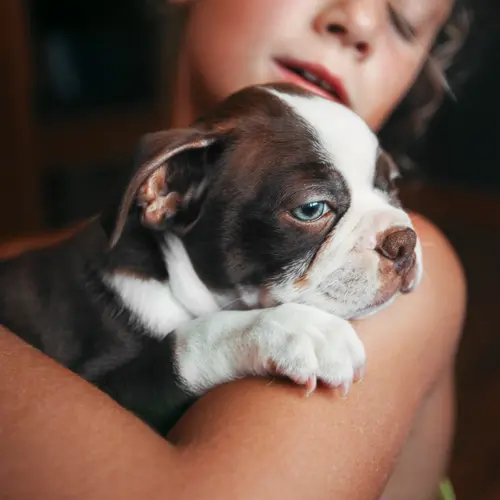

You've heard the stories: a dogs is so terrified during a thunderstorm that they jump through a picture window to escape. Or maybe your dog is the one that ate the living room couch while you were out.
We asked Victoria Stilwell, the internationally known author, dog trainer, and star of Animal Planet’s "It’s Me or The Dog," why dogs do these things.
Q: What are the most common fears or anxieties you’ve seen in the dogs you’ve worked with over the years?
A: The biggest one is separation anxiety -- that’s pretty major. It’s when the dog is hyper-attached to the owners and cannot cope when the owners aren’t there.
Another big one is aggression, which is deeply based in anxiety and insecurities. Many dogs that show aggressive response to other dogs or humans have incorrectly been labeled as a dog that’s trying to be dominant. Aggression starts as a purely defensive gesture. But it can become offensive when the dog realizes that they have been successful.
Q: What causes these fears?
A: It can literally be from lack of exposure when young -- lack of socialization. When you have a puppy, you have to introduce it to 100 new experiences and all different kinds of people and all different kinds of dogs in a lot of different environments. You cannot overwhelm your puppy, and you have to make sure all the experiences it has are pleasurable. There’s no doubt that genetic predisposition has a great effect too.
Q: Are some dog breeds more prone to fears or anxieties?
A: Border collies, the herding dogs, because I think they’re bred to be so sound sensitive and to be environmentally sensitive. You’ll find that collies and shelties and even German shepherds can be predisposed to suffering very much from fears and anxieties. It’s almost like they’re wired in a different way. They are hyper-aware.
That’s not to say if you get a border collie your dog’s going to suffer from anxieties. And I’ve had golden retrievers that have had severe separation anxiety or storm phobia. Any dog, really, has the capacity to suffer from it, depending on their upbringing and their predisposition.
Q: What should I do when I see that my dog is afraid of something? Should I comfort them? Ignore them?
A: Obviously, it’s different for every fear. It used to be thought that you should ignore your dog when it was fearful because, if you were giving comfort or attention, you were reinforcing the fear.
But research has shown that’s actually not the case. You don’t want to go completely crazy with your dog and mollycoddle it. But you need to provide a reassuring arm and a reassuring voice and a reassuring presence so that the dog knows you’re there.
Q: How can I help my dog get over these fears?
A: Try to redirect the behavior -- the fear -- onto something more positive, like a game, a toy, some food, or attention. Get the dog to try to focus on something other than the fear.
This is where food plays a really powerful role. You’re actually training the brain to function in a different way. Because the dog’s sense of smell is immeasurably superior to ours, when you activate that sense of smell, you can deactivate the emotion of fear and anxiety. This is something I’m becoming a lot more interested in because, more and more as I do my training and the more dogs I see with fears, the more fascinated I’m becoming with how smell can help a dog overcome fear.
Q: I’ve heard playing a tape of storm sounds at increasingly louder volumes can help a dog get over its fear of thunderstorms. Do you think this kind of desensitizing works?
A: I’ve used it, but only with other therapy. It’s not going to work alone. And there’s no way you can replicate the sounds of a real thunderstorm. There’s also a theory that dogs feel static electricity. Long before the storm comes, dogs feel changes in the barometric pressure. I don’t think we can really comprehend how a dog feels. I think it’s the noise, it’s the visual of lightning, and it’s maybe the static shocks it’s getting.
Therefore, when I have a thunderstorm-phobic dog, I give the dog a place to go to, like the basement, where the dog can take itself off to, or a closet, which is warm and dark, and I’ll leave a radio or television on. I will do desensitization work with sound because I don’t think it can hurt. Do everything you can to help your dog cope.
Q: What do you think of medicating dogs with strong fears?
A: I’ve only ever put two dogs on medications in 14 years of training. Research has been done, and the evidence is pretty conclusive that a trauma can lead to posttraumatic stress in a dog, exactly like it can in a human. If a dog is too stressed and so wild, you have to get the dog to a point where it can learn. So that’s where I would use medication. But it’s always used with a veterinarian’s consultation and prescribed by a vet. And it’s never for life. It can take around three to six weeks for the medication to work. It’s different for every dog. So normally, maybe for three months, I’d have it on medication.
Q: Why does my dog go nuts and tear up my house every time I leave? How can I stop this from happening?
A: This is separation anxiety -- the excessive chewing to relieve the stress it feels; continual barking; pacing; whining. Sometimes, if it’s really excessive, a dog will chew through walls. I’ve had dogs jump through windows, through glass, to get outside. Most of the destruction is centered on points of exit.
You have to do what I call independence training. You have to stop the hyper-attachment. You have to give your dog the ability to cope. I desensitize a dog to departure triggers, for instance. The dog’s watching you. You’re putting on your clothes, you’re putting on your make up, you get your keys, and the stress starts when you’re putting on your makeup. They know you’re going to leave, so they start to fret and get very anxious. So we start to desensitize them to the triggers. You put on your makeup and you don’t leave. You put on your coat and you stay in the house. You break your ritual completely. You go out the door and you come right back. And you do it 50 times a day.
Q: Can my dog be cured of their fears and anxieties? Or do I just have to learn how to control their problems?
A: A lot of dogs can be modified to a point where they don’t suffer from it any more. But I don’t ever like to use the word "cured."
A lot of cases can be made 90%, 95% better. Some just 60%. Separation anxiety is one of the hardest because it’s so difficult to work with. And aggression is wildly misunderstood. But when it is understood, it can take a while for a dog to feel confident and calm.
There’s no amazing quick fix. You’re talking about behavior. You’re talking about the way the brain reacts. If you’re a human and you’ve got a real anxiety, you’re not going to get better after just one visit to the psychiatrist. It’s going to take a lot of therapy to get you to the point where you feel better. And it’s exactly the same with dogs.
Q: What can I do to keep my new puppy from developing fears and anxieties?
A: The primary socialization window, when the dog’s brain is like a sponge and it’s learning and taking cues from its environment, is between birth and 16 weeks. But before 16 weeks you have to be careful of taking a dog out because of its vaccinations.
This is a real discrepancy between veterinarians and trainers. You have to be careful, but you also have to find ways to socialize before 16 weeks. Socialization isn’t going to work with just meeting a few people and seeing a few cars drive along the road.
It’s got to be a lot of experiences with all different shapes and sizes of people, and colors and races, different environments, houses, homes, streets, busy streets, trucks, you name it. And all of it has to be very positive. Every experience. Everything.