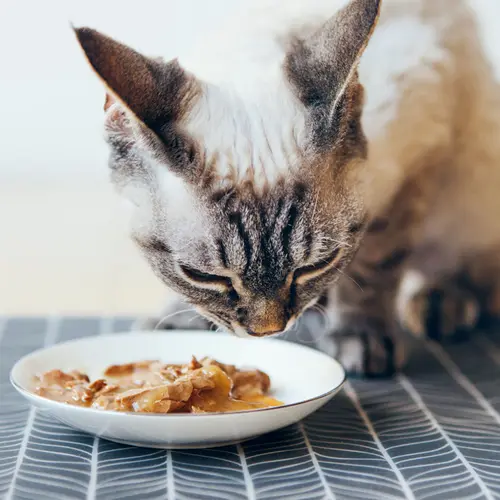

We make plenty of mistakes feeding ourselves. We eat too much sugar and salt, we eat too little, then too much. With all the problems we have with our own diets, is it any wonder we make mistakes when feeding our cats?
So what errors are we making and why? Our cats can’t tell us, not with words. Sometimes we don’t know where we’ve gone wrong until our cat is sick.
Not to worry. WebMD went to the experts in cat health -- veterinarians and animal nutritionists -- and asked them to outline the most common cat feeding mistakes so that you can avoid them and help your feline friend stay fit, feisty, and well-nourished.
Cat Feeding Mistakes: Too Much Food
Probably the most common mistake people make when feeding cats is over-feeding, says Joe Bartges, DVM, PhD, DACVIM, DACVN, professor of medicine and nutrition, the Acree Endowed Chair of Small Animal Research, in the College of Veterinary Medicine, at the University of Tennessee. “Obesity is the most common nutritional disease seen in cats.”
Although a pudgy kitty may look kind of cute, obesity is associated with cat health issues including diabetes, arthritis , and urinary tract disease. In fact, Bartges tells WebMD that cats may suffer from something similar to that very human condition, metabolic syndrome.
It’s not necessarily that we’re intentionally giving our cats more food than they need, says Linda P. Case, MS, author of The Cat: Its Behavior, Nutrition, and Health. It’s that our kitties “are more sedentary, as compared to the days when they were barn cats and more active. They're little couch potatoes now, their nutrition needs are much lower, so it's easy to overfeed them.”
So how much food does your cat need? That’s a question best answered by a professional, though recommendations range between 24 to 35 calories a day per pound, to keep cats at a normal, healthy weight.
Yet many of us don’t really know what normal looks like, so “I encourage people to ask their vet to help them determine their cat's body condition score,” says Susan G. Wynn, DVM, a veterinary nutritionist in Georgia and author of Manual of Natural Veterinary Medicine. “That way they will recognize abnormal and work toward normal.”
Cat Feeding Mistakes: Feeding Only Dry Food
“The biggest mistake people make is feeding cats dry food,” says Lisa A. Pierson, DVM, a California veterinarian focused on feline medicine and nutrition, and creator of CatInfo.org.
As it turns out, today’s domestic tabby evolved from desert-dwelling ancestors, a heritage that no doubt left our furry felines with their grace, hunting prowess -- and low thirst drive.
“We know that a cat’s sensitivity to thirst is blunted compared to a dog,” Case says. “They don't voluntarily drink water like a dog would.” And because cats naturally produce highly concentrated urine “we're setting them up for urinary tract problems when their diet is low in liquids.”
“When cats present with urinary tract problems, the recommendation is to get them on a water-rich diet,” Pierson says. “However, why are we closing the barn door after the horse is a mile down the road? Why not practice preventive nutrition by feeding them [moisture-rich] canned food before they end up with urinary tract problems?”
Cats are designed to get their water with their food, Pierson says. Although mice, a cat's normal food, are about 70% water, and canned food about 78%, dry food is between 5%-10% water. That's why “canned food does a much better job of keeping your cat well-hydrated,” Pierson tells WebMD. “Think of canned food as hosing down your cat's bladder several times a day.”
Cat Feeding Mistakes: Offering Too Little Water
Clearly water is vital, for cats as well as people. Essential to life, water accounts for 60% to 70% of an adult cat’s body weight, say ASPCA experts. A serious water deficiency can have critical repercussions for pets, causing serious illness or death.
Although wet foods can go far toward meeting your feline friend’s water needs, cats should also have several sources of fresh water available through the house, say the pros. “Pay attention to where the cat likes to be so that there's water there,” Case suggests. “And be aware that some cats prefer running water; others can detect the taste of chlorine in tap water so you might want to buy bottled water for them.”
Here’s a tasty tip to help encourage your cat to drink more, offered inThe Veterinarians’ Guide to Natural Remedies for Cats:
- Locate a couple leaves of fresh catnip
- Fill a bowl with water and crush the leaves under the water
- Sit back and watch susceptible kitties ‘go wild’
Cat Feeding Mistakes: Adding Garlic for Tapeworms
Some of us have seen those strange wiggly white segments near our cat’s posterior. About the size of rice grains, those segments belong to a tapeworm that’s taken residence in your cat’s small intestine. Some believe the best home remedy to foil these squirmy parasites is fresh, pungent garlic added to kitty’s chow.
“This is one of the biggest misconceptions around,” Bartges tells WebMD. “There is no proof that garlic prevents any parasitic infestation, including intestinal worms or fleas.” On top of that, if given in too high of a dose, garlic can destroy a cat’s red blood cells.
The most common parasite found inside adult cats, tapeworms are usually caused by kitty swallowing a flea. Although tapeworms aren’t life-threatening, they can lead to weight loss, vomiting, abdominal discomfort, and other issues if left untreated.
So why garlic to the rescue? “I believe the origin of this is that people thought garlic prevents fleas,” Case says. “But feeding your cat garlic doesn't prevent fleas or prevent tapeworms.”
If you notice tapeworm segments in your cat’s feces or near the anus, talk to your veterinarian, who will probably prescribe a deworming medication. Don’t treat kitty’s worms yourself -- not all treatments work on all worms and you could end up doing more harm than good with the wrong medication.
Cat Feeding Mistakes: Going Vegetarian or Vegan
According to some vets, another up-and-coming mistake made when feeding cats is trying to make cats vegetarians or vegans.
Cats are obligate carnivores, meaning they must eat mainly meat and animal organs to thrive. The amino acid taurine, for example, is found only in animal tissue. Lack of taurine can lead a cat to experience heart problems, blindness, and even death.
“The nutrients cats need that come from meat, can be provided in the food synthetically,” Case says. “But you have to be very careful, and aware of the cat's nutritional idiosyncrasies.” Because most of us aren’t quite sure of our own nutritional needs, it can be next to impossible to guess the needs of our cats.
Cat Feeding Mistakes: Creating Nutrient Deficiencies
The interest in homemade food for cats (and dogs) is on the rise, say the pros. It is important to realize however that homemade does not always mean healthy.
“A mistake that I often see well-meaning people make is the feeding of unbalanced homemade diets,” Pierson says.
That’s because when making cat food from scratch, some people fail to balance the meat with the correct amount of calcium, forgetting “that a cat would be eating both the meat and bones of their prey, which provides a proper calcium-to-phosphorus ratio.”
A cat diet too heavy in tuna, liver, or liver oil (such as cod liver oil), can lead to vitamin A toxicosis, resulting in bone and joint pain, brittle bones, and dry skin. A diet too rich in raw fish can destroy vitamin B1, causing muscle weakness, seizures, or brain damage. “If a feline caregiver wishes to make their pet's food, they need to follow a properly balanced recipe,” Pierson says.
One way to do that is to start by talking to your veterinarian, who can guide you away from food fads and steer you toward a balanced, healthy eating plan for your cat.